



Ordering 12 shirts for a school club, one hoodie for a new hire, and 75 event tees used to mean juggling different print methods, setup fees, and order rules. Print on demand apparel changes that. It gives organizations and individuals a simpler way to create custom clothing without committing to large quantities, limited color counts, or a long, complicated setup process.
For many buyers, that flexibility is the difference between getting apparel ordered this week and putting it off for another month. If you manage a team, run a school program, organize events, or sell branded merchandise, print on demand can remove a lot of friction. The key is understanding where it fits best, where it has limits, and how to set up your order for a result that looks sharp and arrives on time.
What print on demand apparel means in practice
At its simplest, print on demand apparel is custom clothing produced as orders are needed rather than printed in bulk ahead of time. Instead of buying a large run of shirts and storing inventory, you can print one item, a small batch, or recurring orders as demand comes in.
That matters because most buyers do not have perfectly predictable needs. A small business may need staff polos now, then replacement tees next month. A nonprofit may want fundraiser shirts without risking leftover boxes in a storage closet. A family reunion planner may only need a limited number of sizes, with a few last-minute additions.
Digital printing is what makes this model especially useful. Unlike traditional methods that often require more setup and can become less practical for short runs, digital printing supports full-color artwork, faster production, and lower barriers for smaller orders. That means no minimums can actually be realistic, not just a marketing phrase with hidden trade-offs.
Why print on demand apparel appeals to so many buyers
The biggest advantage is flexibility. You can order one piece or hundreds, test a design before committing to a larger run, or support ongoing merchandise sales without tying up cash in inventory. For schools, clubs, and office teams, that reduces waste and makes planning easier.
Cost control is another major reason buyers choose this route. With digital decoration, full color at no extra charge can make a real difference, especially when your logo or artwork includes gradients, multiple shades, or photo-style graphics. You are not forced to simplify a design just to make the print method fit the budget.
Speed also matters. When there is no lengthy screen setup, production can move faster. That is useful for event planners on tight timelines, HR teams onboarding employees, or coaches who discover mid-season that they need more gear.
There is a practical convenience factor too. Many buyers are not designers, and they should not need to be. A user-friendly online design tool, combined with access to real support when needed, makes custom apparel much more manageable for first-time buyers and busy repeat customers alike.
When print on demand apparel is the right choice
Print on demand apparel works especially well when order sizes are small, artwork is colorful, or future demand is hard to predict. That covers a wide range of common use cases.
A small business launching branded merchandise often starts here because it avoids the risk of over-ordering. A school club can create spirit wear without forcing every student to commit at the same time. Event organizers can handle volunteer shirts, staff apparel, and small post-deadline additions without rebuilding the entire order process.
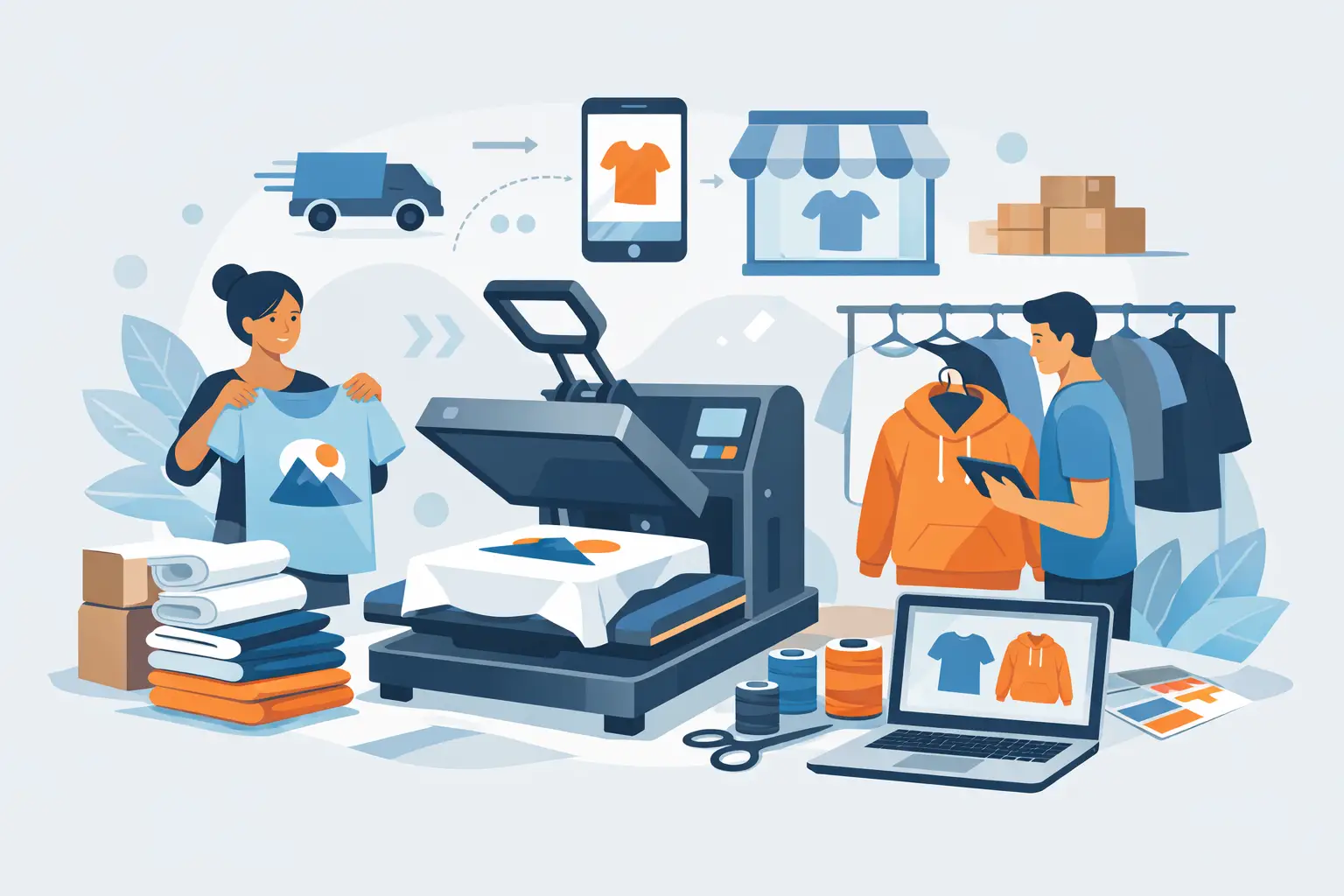
It is also a strong fit for organizations that need a mixed product catalog. You may want t-shirts for a fundraiser, hoodies for staff, youth sizes for a school event, and hats for resale. With digital printing and a broad product selection, it becomes easier to keep branding consistent across categories.
For ongoing programs, print on demand can support managed storefronts or recurring ordering systems. That setup helps businesses, teams, and nonprofits offer approved branded apparel year-round without managing boxes of inventory internally.
Where print on demand apparel has trade-offs
It is not the answer to every order. If you need a very large run of identical items and your artwork is simple, another print method may sometimes make more sense from a cost-per-piece standpoint. Volume, garment type, design coverage, and deadline all affect what is most efficient.
Garment selection matters too. Not every fabric behaves the same way, and not every design belongs on every product. A lightweight tee, a heavyweight hoodie, and a performance polo may all require different expectations for texture, color presentation, or print placement.
There is also a difference between a design that looks good on a screen and one that prints well on apparel. Fine details, low-resolution images, and artwork without proper contrast can create avoidable issues. That is why support matters. The best ordering experience is not just self-service. It is self-service backed by people who can step in before a bad proof becomes a disappointing final product.
How to get better results from print on demand apparel
Start with the purpose of the order, not just the artwork. Ask what the apparel is supposed to do. Is it for employee branding, school spirit, fundraising, resale, team unity, or a one-time celebration? The answer affects garment choice, budget, and how polished the final product needs to feel.
Next, choose products your audience will actually wear. A cheap tee may lower the initial cost, but if the shirt stays folded in a drawer, it did not do its job. For workplace branding, polos or soft retail-style tees may be a better fit. For events, standard short sleeve shirts often make sense. For cooler seasons or premium merch, hoodies and sweatshirts tend to carry more perceived value.
Then pay attention to the design itself. Strong custom apparel usually has a clear focal point, readable text, and enough contrast to stand out on the garment color. Full-color printing gives you more freedom, but more freedom does not always mean more elements. Clean, intentional artwork often performs better than overcrowded layouts.
Finally, think through ordering flexibility before you place the first order. If you expect reorders, size additions, or ongoing sales, choose a process that can scale with you. That might mean using a design platform that saves your artwork, requesting support for repeat projects, or setting up a storefront for your organization.
What businesses, schools, and event planners should look for
A good print partner should make ordering easier, not create another task to manage. That starts with transparency. No minimums should mean no minimums. Full color should not trigger surprise charges. Production expectations should be clear from the start.
You should also look for a broad apparel catalog. Different groups need different products, and it helps when you can source tees, long sleeves, hoodies, polos, tank tops, hats, and youth apparel from one place. That reduces administrative hassle and keeps branding more consistent.
Support is just as important as product range. Some customers want to build everything themselves in an online design tool. Others need help refining artwork, choosing the right garment, or setting up a repeatable ordering system. A reliable provider should be able to handle both.
This is where a service-minded model stands out. Custom Tees Direct, for example, is built around convenience – no minimums, full-color digital printing, design support, and ordering options that work for one-time purchases as well as ongoing merch programs. For buyers balancing speed, budget, and quality, that kind of structure solves real operational problems.
Why print on demand apparel keeps gaining ground
The way organizations buy apparel has changed. Buyers want smaller runs, faster turns, and fewer setup headaches. They want to test ideas, reorder without friction, and avoid wasting money on leftover stock. Print on demand apparel lines up with those expectations because it is built around flexibility rather than bulk-first production.
That does not mean every order should be handled the same way. Smart buying still depends on quantity, garment type, artwork, and timing. But for a growing number of businesses, schools, teams, nonprofits, and event organizers, print on demand is not a backup plan. It is the most practical starting point.
If you are trying to make custom apparel easier to order, easier to manage, and easier to get right, the best next step is usually the simplest one: choose a process that lets you start with what you need now and scale when you are ready.