



When you are ordering custom shirts for a team, staff event, school fundraiser, or one-time celebration, the print method affects more than just how the design looks. In the digital printing vs screen printing decision, the real questions are usually simpler: How many pieces do you need, how fast do you need them, and how much design flexibility do you want?
That is where a lot of buyers get stuck. One method is not universally better than the other. The right choice depends on your artwork, your quantity, your timeline, and how much setup complexity you are willing to deal with.
Digital printing vs screen printing: the core difference
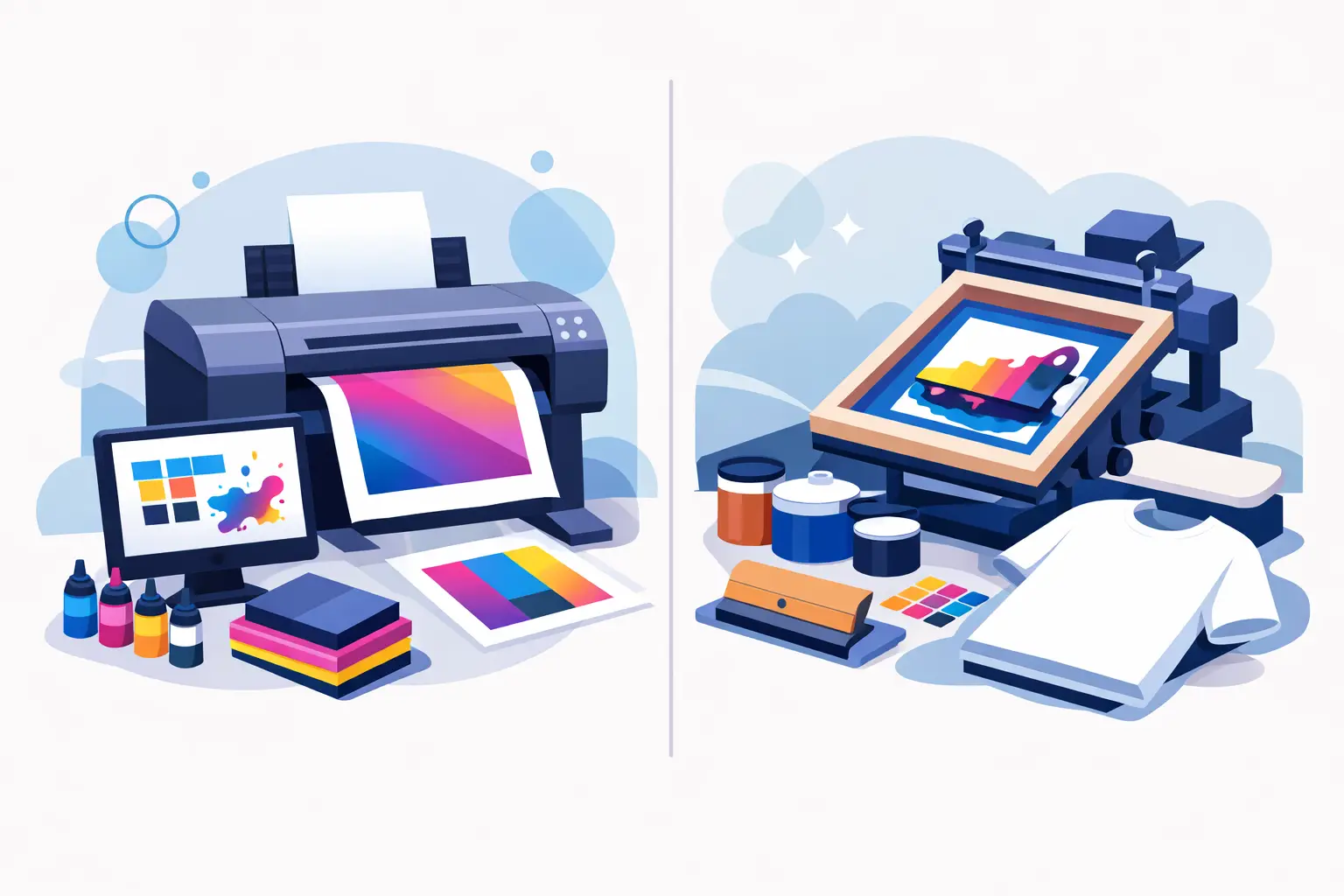
Digital printing applies the artwork directly onto the garment using specialized inkjet technology made for textiles. It is built for full-color designs, fine detail, and flexible order sizes. You can print one shirt, a dozen, or a mixed batch without rebuilding the design for every color.
Screen printing works by pushing ink through a stencil, or screen, one color at a time. That process has been around for a long time because it is effective for bold graphics and larger production runs. But it also comes with more setup, more limitations on color complexity, and more planning upfront.
For many customers, the simplest way to think about it is this: digital printing is usually the easier fit for detailed, full-color artwork and smaller or mixed orders, while screen printing tends to make more sense for simpler designs ordered in higher volumes.
When digital printing makes more sense
If your design includes gradients, shading, small text, photo elements, or multiple colors, digital printing is often the more practical choice. It handles complexity without turning every additional color into another production step.
That matters for businesses and organizations that want their branding to stay accurate. If your logo uses several colors or you want a polished front graphic with crisp detail, digital printing keeps the process straightforward. You are not paying for separate screens just to reproduce a more complete design.
It also works especially well when quantities are unpredictable. Maybe your office needs 14 polos for a trade show. Maybe a school club needs 23 shirts in mixed youth and adult sizes. Maybe a family reunion starts with 12 pieces and grows to 19 after the RSVP deadline. Digital printing is built for that kind of flexibility.
Another big advantage is speed. Because there is less setup involved, orders can move into production faster. That is useful when you are buying on a deadline or managing a last-minute event.
For customers who want no minimums, fast turnaround, and full color at no extra charge, digital printing usually lines up better with how they actually shop.
Best uses for digital printing
Digital printing is a strong fit for employee apparel, school spirit wear, event shirts, nonprofit fundraising items, personalized gifts, and short-run branded merchandise. It is also ideal when each order may need to be placed as needed instead of all at once.
That is one reason it works well for online merch stores and print-on-demand programs. You can order what you need when you need it, instead of committing to bulk inventory upfront.
When screen printing still has a place
Screen printing can still be a good option, especially for large runs with simple artwork. If you are printing a one-color or two-color design on hundreds of shirts, the setup becomes easier to justify because it is spread across more units.
It is often chosen for bold, solid graphics where exact photographic detail is not the goal. Think basic team shirts, straightforward event branding, or simple logo placement in large quantities.
There is also a visual and tactile difference. Screen printing tends to lay down ink in a thicker way, which some buyers prefer for certain graphic styles. On the right design, that can be a benefit rather than a drawback.
The trade-off is that every additional color adds more production work. The more complex the design gets, the less convenient screen printing becomes. That can affect price, timing, and art preparation.
Best uses for screen printing
Screen printing makes the most sense when the artwork is simple, the color count is limited, and the order size is high enough to offset setup. If you are organizing a large event and everyone is getting the same basic shirt, it can be a practical route.
Cost is not just about price per shirt
A lot of buyers compare print methods by looking for the cheapest unit price. That matters, but it is not the whole picture.
With screen printing, setup costs can be the deciding factor. Screens have to be created for each color, and that cost gets built into the job. On a large order, that setup may be spread out enough to make the final per-shirt price attractive. On a small order, it can make the total less efficient very quickly.
Digital printing usually avoids that issue. Because there are no per-color screen charges, smaller orders and detailed artwork often become much easier to budget. If you only need a handful of shirts, or if your art is full color, digital can deliver better overall value even if you are not comparing methods on a purely high-volume basis.
This is where buyers should think operationally. Are you trying to minimize total spend on the actual order in front of you, or are you trying to maximize unit savings at a quantity you may not even need? Those are not the same decision.
Artwork quality and design freedom
This is one of the clearest differences in digital printing vs screen printing.
Digital printing gives you more freedom with artwork. Full-color logos, gradients, soft transitions, texture, and photographic images are all easier to reproduce. That is important for modern branding, where a logo may include several color shifts or a design may need a more polished retail-style look.
Screen printing performs best with cleaner, simpler art. It can absolutely produce strong-looking apparel, but the design often needs to be prepared with the print method in mind. Fine details may need adjustment. Color blending may be limited. Some designs have to be simplified to print well.
For buyers who do not have an in-house designer, that difference matters. A more forgiving print process saves time and reduces revisions. It also makes it easier to move from idea to finished apparel without getting buried in technical prep.
Order size, reorders, and flexibility
Not every apparel order is a one-time bulk purchase. Many organizations reorder in waves. New employees need company shirts. Late signups join the team. Additional family members want reunion apparel after seeing everyone else wear it.
Digital printing is often better aligned with that reality. You can place small follow-up orders without the same level of setup friction. That keeps your process simple and helps you avoid overordering just to make a print method work financially.
Screen printing can be efficient when you know the full quantity from the start and the design will stay exactly the same. But if you expect changes, size mix adjustments, or ongoing reorders in lower quantities, it may feel less flexible.
That is why many practical buyers choose based on how they will order over time, not just on the first order alone.
Which print method is better for your project?
If you need detailed art, multiple colors, quick turnaround, or a small order, digital printing is usually the better fit. If you need a high-volume run with a simple design and consistent specs, screen printing may be worth considering.
For many businesses, schools, teams, and event planners, convenience is the deciding factor. They want a process that is easy to manage, works for any order size, and does not punish them for using full-color artwork. That is exactly why digital printing has become the preferred option for so many modern apparel orders.
At Custom Tees Direct, that is the focus: making full-color custom apparel easier to order, whether you need one shirt or a larger group order, and whether you are designing from scratch or working from an existing logo.
The best print method is the one that fits how you actually buy. If your order needs flexibility, speed, and visual detail without extra complexity, digital printing is usually the smart move. Start there, and the rest of the project tends to get a lot easier.